
Eric | An Essay on Terry Pratchett’s 9th Discworld Novel
Faust Eric
Essay by T. L. Bainter
Overview
We’re nearly in the double digits, now! Eric is the ninth Discworld novel and the fourth Rincewind novel. I make no secret of the fact that the Unseen University Collection is my least favorite collection within Discworld, but is Eric better or worse than the others I’ve read so far in my chronological readalong?
The 4th Rincewind Book
As the 4th novel starring Rincewind as a main character (or at least as one of the main characters), we’ve had plenty of time to adjust to Rincewind as a character. Rincewind is very much a love-him-or-hate-him kind of character—it’s hard to be neutral on the failed, bumbling wizard who stumbles into saving the world time and again. Despite my lack of love for the Unseen University Collection, I do actually love Rincewind as a character, which is good because I… really didn’t like Eric as a character.
In the previous Rincewind novel, Sourcery, we ended with Rincewind entering the Dungeon Dimensions, presumably forever. Even rereading Sourcery myself, I remembered there’s more Rincewind in later novels (and there’s a hint to Rincewind’s eventual return at the end of the novel), but initially could not recall how or when Rincewind returned. Well… here’s our answer: Rincewind returns in Eric, having been summoned via the Microsoft Disk Operating System.
A Retelling
Eric is a parody. The original covers of Eric make this abundantly clear by crossing out the title Faust and replacing it with Eric, but Faust isn’t the only thing parodied here. There are direct references to greek mythology (including entire sections of the novel that insert our characters into the Discworld equivalent of the trojan war), Dante’s Inferno, and more. To my knowledge, this may be the most parodic Terry Pratchett novel thus far, following multiple stories beat-for-beat before coming to its conclusion. Despite my love for mythology instilled in me from a young age (when I got to pick out a novel as part of a Christmas excursion with my grandmother as a child, I picked up The Iliad, which I still have in my possession), I actually found that this detracted from the story overall, making it less enjoyable for me than it otherwise could have been. Thankfully, this novella is quite short, so the parody doesn’t overstay its welcome.
This Post
What to Expect from This Post
For the remainder of this post, we’ll discuss the characters, plot beats, and nuances of Terry Pratchett’s Eric before getting to the opinion section, wherein I’ll talk about my own thoughts on Eric followed by reading and discussing the thoughts of other participants in this readalong. Finally, we’ll give Eric a star rating and get cracking on the next book.
The Readalong as a Whole
If this is your first time checking out my Discworld readalong, this post is part of my ongoing series in which we are reading through the entirety of the main Discworld series. After this post, we’ll be reading Moving Pictures, giving you the opportunity to share your own thoughts, which I will talk about in the next readalong post. In fact, now that this is live, you can go share your thoughts and star rating for Moving Pictures right now! The link is up and you’re able to give me your thoughts up until the point at which I begin drafting the next readalong post, so you have plenty of time to go read that book and come back to provide your own opinion.
The Story
As always, this Discworld novel is filled with references. I couldn’t possibly get to them all in this post without it just turning into a long list, but I’ll absolutely be calling out some of my favorite, more subtle references that may have been missed during your own read-through. If I don’t mention a reference or joke you loved, feel free to let me know! Who knows—maybe I missed that one, myself.
Prelude
At the end of Sourcery, Rincewind confronts Coin and—by proxy—Ipslore. As other wizards flee, our unlikely hero Rincewind grabs Coin and drags him to the Dungeon Dimensions with the Luggage following shortly after. Coin is able to escape the alternate dimension, but Rincewind and the Luggage remain behind. There’s a hint, however, that Rincewind will return; on the final page of the book, the Librarian places what remains of his hat on a pedestal and a later line reads “No matter how far a wizard goes, he will always come back for his hat.”
In Eric, Rincewind finally comes back for his hat, though not entirely of his own volition, as he is instead summoned by a small twerp with a demonic user manual at his disposal… the titular Eric.
Characters
In addition to Luggage—who needs no introduction for everyone knows and loves them—there are two main characters in this novel: Eric and Rincewind. Eric is a newcomer to the series while Rincewind is well-known and beloved at this point, though he has been absent for the last three Discworld novels, our longest gap between stories featuring Rincewind thus far.
Rincewind
Assuming you’ve been following along with this readalong, you should already know who Rincewind is: a failed wizard who has somehow managed to save the world (or at least a region of it) multiple times. As he stumbles into victory time and again, faces near-death numerous times yet emerges either unscathed or lightly scarred, Rincewind meets unlikely characters, traverses dimensions, and generally continues to make a bit of a fool of himself. However, despite how bad Rincewind is, he’s nothing compared to…
Eric
I have never met a good-natured Eric, let alone one who can take a joke. Feel free to prove me wrong in the comments. The titular Eric of this novel is no exception. He’s entitled, whiny, self-aggrandizing, and generally just a giant pain to deal with. Part of this is definitely an intentional characterization, but an unlikeable main character is tough to pull off and a character who makes Rincewind look good… that’s a problem.
Outline
Introduction
When reflecting on this novel, it’s tough to remember that it doesn’t kick off with Eric summoning Rincewind. There’s actually a lengthy section at the beginning that goes on for 12 pages before Rincewind is actually summoned. We actually get what may be one of the best opening paragraphs I’ve seen in a Discworld novel thus far, which I’ll quote below:
“The bees of Death are big and black, they buzz low and sombre, they keep their honey in combs of wax as white as altar candles. The honey is black as night, thick as sin and sweet as treacle.”
This opening paragraph paints such a vivid picture and shows just how excellent Pratchett’s prose really was. It’s also a hilarious contrast to the later element of the page, which ends with:
“oshitoshitoshit, I’m gonna die I’m gonna die I’m gonna DIE!”
We find out that this thought Death hears is from Rincewind himself, later confirmed for the wizards of Unseen University. I do love how that scene ends, with a wizard telling Death “Goodbye” and Death replying “Be seeing you”. It’s such a fun little quip; I love Death. Death has been my favorite character since I was a child and that sentiment has only grown since then.
Summoning
Finally, on page 12, Rincewind appears in the story having been summoned by young lad Eric Thursley via a magic circle. Eric is quite certain Rincewind is a demon or some other powerful being capable of fulfilling his three wishes: ruling the world, meeting the most beautiful woman ever, and immortality… oh, and a little add-on wish of “a chest full of gold… just to be going on with.” No big deal and certainly something Rincewind can handle! Or… not. A crestfallen Eric Thursley is told by Rincewind he isn’t able to deliver on these wishes… though he will deliver on them throughout this story nonetheless.
While Eric is downstairs with his mother getting a cup of tea, Rincewind spots that the book Eric used to summon him was the Mallificarum Sumpta Diabolicite Occularis Singularum, or the Book of Ultimate Control, though the latin for this translates to The Hal 9000 User Manual. More interestingly (at least in my opinion), is that the acronym for the book, MSDOS, is the same as the acronym for the Microsoft Disk Operating System. So it’s all to do with computers. None of this is apparent to Rincewind, of course; apparently none of the dungeons in the Dungeon Dimensions can only be navigated via Command-line.
We then learn through a scene taking place elsewhere that Rincewind wasn’t supposed to be summoned because someone else was supposed tobe summoned: Duke Vassenego, who was to offer Eric “forbidden pleasures and dark delights”. Demon King Astfgl is quite upset Rincewind was summoned instead… and thus the story’s conflict begins.
Tezuman Kingdoms
Rincewind discovers he does seem to have some powers he was not aware of. He snaps his fingers and creates a puff of smoke, then snaps them again and teleports to a jungle with Eric. Eric is excited not about the lost kingdoms in the area but at the possibility of there being Amazonian princesses (ew). They have actually taken to the Tezuman Kingdoms, which has many riffs on the Aztecs, such as the Tezuman god being Quezovercoatl (instead of Quetzalcoatl).
Rincewind, in his effort to grant the wishes of Eric, attempts to get a tribute for the boy. They’re taken to a grand feast, but learn that they are due to be sacrificed to Quezovercoatl, who is later summoned at the behest of the demon king. Escaping is easier than expected, however, as Quezovercoatl turns out to be very small… and short-lived.
“‘Now then,’ [Quezovercoatl] began, ‘this is very important—’
Unfortunately, no-one ever found out why. At that moment, the Luggage breasted the top of the pyramid, its legs whirring like propellers, and landed squarely on the slabs.
There was a brief, flat squeak.”
Tsort
With Quezovercoatl squished into oblivion by the Luggage, Rincewind and Eric flee with a snap of Rincewind’s fingers, traveling elsewhere in history despite Rincewind’s intent to take them back to Eric’s room. They instead wind up in the midst of the Discworld-equivalent of the Trojan War, first appearing in a giant wooden horse with no one else in it. Eric does have a rather funny quip here:
“Fat chance of finding the most beautiful woman in the world in a dump like this,”
Rather amusing given that, famously, this is a war started because the most beautiful woman in the world is here… if you haven’t caught the joke, yet.
Anyway, their attempt to flee leads to accidentally letting in the Ephebians who are at war with the Tsortians. They make contact with Elenor of Tsort (Helen of Troy’s parallel, of course) and Lavaeolus (Odysseus), whose name Eric claims means “rinser of winds”. Once he knows that Rincewind and Eric are from the future, Lavaeolus asks if he makes it home safely, to which Rincewind lies:
“You get home okay… You’re well-known for it, in fact. There’s whole legends about you going home.”
Rincewind snaps his fingers again to take them to…
Hell
Okay, actually, let’s rewind because there are some other things that happen before reaching Hell at the end of the book. Rincewind and Eric meet the Creator, which does have an amusing moment or two. After that, they go to…
Hell
…and then they later encounter Urglefloggah, who has a great line:
“‘Where are we?’ said Rincewind.
Various mouths beamed. ‘Quail, mortals!’
‘What? We’re in a bird?’
‘Grovel and cower, mortals!’ the demon corrected itself.”
Urglefloggah serves as a guide through Hell, wherein it is revealed Duke Vassenego wanted to restore Hell to its natural order and gave Rincewind his powers to distract King Astfgl while his own machinations proceeded (King Astfgl was far too bureaucratic for Vassenego’s liking). Once Astfgl is left permanently distracted by his own red tape, Vassenego lets Rincewind and Eric go and that’s… that’s it.
Opinions
That’s the story of Eric in a nutshell. No, genuinely. That’s it. So let’s get to the meat and potatoes of this post: opinions.
My Opinion
The Book as a Whole
I’m not going to sugarcoat it: Eric is my least favorite of the Discworld novels thus far in our chronological readalong. Thinking back to all the other novels, it may even be my least favorite Discworld novel of all. Terry Pratchett is my favorite author and Discworld is my favorite series, but this book is genuinely just… not great. It has terrific references, excellent prose, and is an all-around solid parody, but I’m left with the same feeling I have when I watch most 1-to-1 parodies like Vampires Suck or The Hungry Games: “That was fine, but it would have been better bite-sized”. I know Eric is already bite-sized—it’s a Discworld novella—but I fear it still overstays its welcome.
It’s clear the main point of Eric was to get Rincewind back to the real world, but at the end of the day it doesn’t offer much to Discworld or its readership. You follow the terrible protagonist Eric (who’s absolutely no replacement for Twoflower the Tourist) alongside the confused but amusing Rincewind as they just sort of go from one parody to the next until the story just kind of ends right back where it started. I think Eric is a fun enough story and I’m glad it exists, but I am also left wondering how much better it would have been if it had been called Rincewind, with Rincewind and Eric’s relationship ending once Eric realized Rincewind couldn’t give him what he wanted.
Buddy Comedy
This book follows a similar structure to the very first Discworld novel, The Colour of Magic, which saw Rincewind and Twoflower on a series of pocket-sized adventures, but its co-protagonist Eric is significantly less likeable than Twoflower the Tourist. It’s a divine buddy comedy!
Okay, it’s not divine, but I did want to make that joke.
Anyway, I have generally not been a fan of the buddy comedy genre, so I was soured on Eric from the start, but I can be won over if they’re good. I really wish this one had been, but our protagonists are unlikable and have no real agency in this story, which further pushes me away from connecting with them. Eric Thursley especially is just a horrible character I wanted to hate. At one point, he actually says:
“I want to be a eunuch, sir…because you get to work in a harem all day long.”
He was a one-track mind, idiotic teenager Rincewind ineffectively corrects from time to time. I’d be giving this novel a bump in its star rating if Eric had been left behind in the first kingdom.
I Wish I Had More to Say
Genuinely, I wish I had more to say about this book. Usually, I can pull something out of a Terry Pratchett novel to really chew on, but this book just didn’t leave me with that feeling. It didn’t make me want to ruminate on it. The parody elements were largely obvious and on-the-nose, many of the jokes didn’t really land as well as I’m used to Pratchett’s humor landing, and ultimately Eric was just a bit of a dud. I could comment on Pratchett turning the workplace and bureaucracy into a circle of Hell, but I don’t have anything to really add there. I could point out more of his references and parodies, but it feels more like a Ooh look what I know than actually adding to and improving the conversation. I just… don’t have much more to say about this one, unfortunately.
Rating
This is tough to rate. It’s important to note that when I rate novels in this readalong, I’m not just giving them a Discworld tier ranking, I’m giving them an overall star rating. That means if I give it 5-stars, it’s one of my favorite books overall, up there with Pierce Brown’s Dark Age, while a 1-star novel is buried in sludge alongside The Davinci Code.
So while this novel was bad, I can’t imagine putting it under a bunch of sludge. It also did entertain me and it did make me laugh, but it also bored me and left me feeling like I’d wasted my time rather than wanting more like most Discworld novels do.
And so it’s with a heavy heart that I give Terry Pratchett’s Eric… a 1.5. It’s just… not good. I would have preferred a small essay that stops after about 30 pages to what I just read. This was especially disappointing coming off the heels of Guards! Guards!. Terry Pratchett is still my favorite author and Discworld is still my favorite series, but even Sir Terry can’t pump out an absolute banger every single time.
Your Opinion
This next part is where we discuss the opinions of participants in this readalong. If you want your own comments and star ratings to contribute to my essays, you can do so by checking out my Posts tab. The rating post for our next book in this readalong, Moving Pictures, is already up at the time of this writing! You can also give your opinion on Eric in the comments below; I read all of them and I especially appreciate corrections to things I say here (those usually get pinned on YouTube) and notes on things I may have missed.
That said, let’s get to your opinions on Terry Pratchett’s Eric.
Star Rating
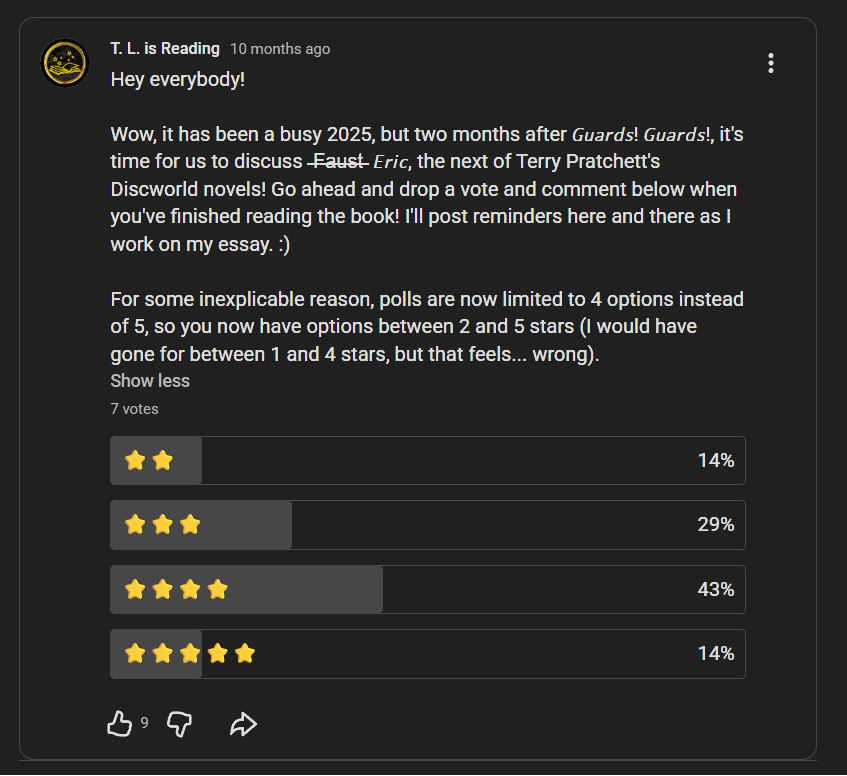
The average star rating from everyone on this novel was a surprising 3.5 stars. I genuinely thought we’d see more low ratings, but some people even gave this novel 5 stars, which really skewed things upward. So I gave it a 1.5 while my co-readers gave it a 3.5. Yet, despite the above-average star rating here… there weren’t any truly positive comments on the post.
The Typing Ape
The Typing Ape says:
“My favorite part is that summoning a demon characterizes modern dating all too well.”

Thanks for your comment, Typing Ape! That said, please elaborate.
Do you mean that when you try to go on a date with someone, they demonfish you not of their own volition, but because another demon didn’t want to go on the date and instead chose to send some other rando, but with all their powers? I dated for a while in the modern age before finding my girlfriend and weirdly did not experience that scenario.
Wolervine
Wolervine says:
“It’s a low three, one of the least of all the books, yet there’s still a lot to amuse in there. Satire of the workplace is the most successful.”

Thinking back on it after reading this comment, I did enjoy the bureaucratic satire more than anything else. Maybe just because that’s the life I live, but Eric’s strongest element was certainly the Hell portion of the story. I wish there had been more of that. It does take up a good portion of the end, but at that point I was so burned out on the book at that I really wasn’t enjoying much of what I was reading, even the parts that amused me.
Thanks for your comment, Wolervine (man, writing software does not like your username)!
Amy Myers
Amy Myers says:
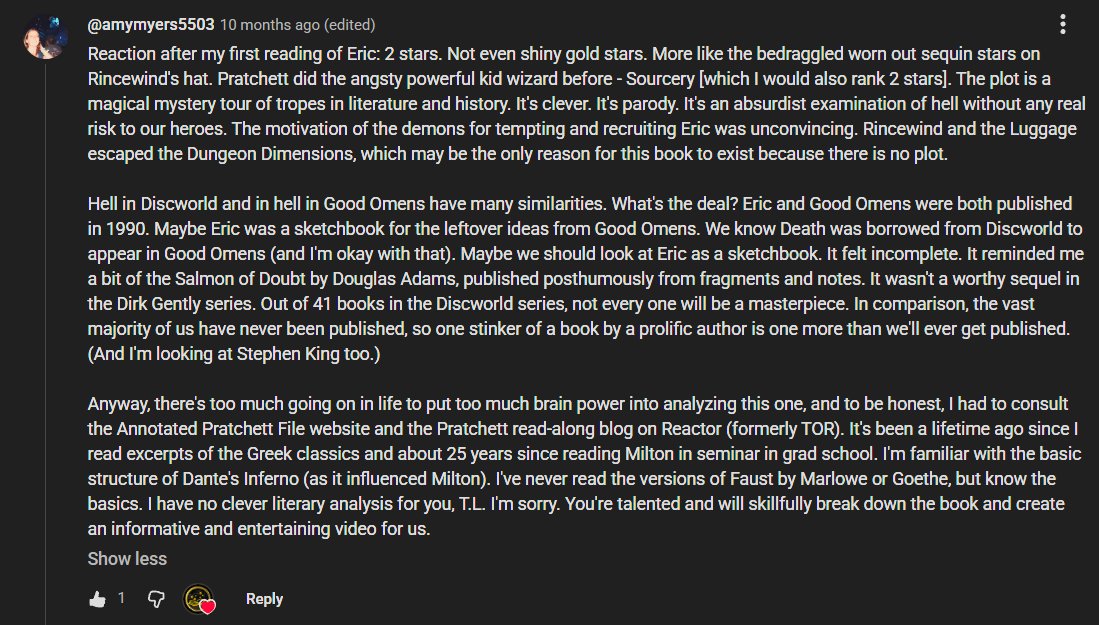
“Reaction after my first reading of Eric: 2 stars. Not even shiny gold stars. More like the bedraggled worn out sequin stars on Rincewind's hat. Pratchett did the angsty powerful kid wizard before - Sourcery [which I would also rank 2 stars]. The plot is a magical mystery tour of tropes in literature and history. It's clever. It's parody. It's an absurdist examination of hell without any real risk to our heroes. The motivation of the demons for tempting and recruiting Eric was unconvincing. Rincewind and the Luggage escaped the Dungeon Dimensions, which may be the only reason for this book to exist because there is no plot.”
I’m glad we came to so many of the same conclusions, here (we typically do!). I am dead on there with you that this book exists solely to bring Rincewind and the Luggage back from the Dungeon Dimensions—there just isn’t enough plot or originality to justify the story’s own existence, otherwise. I hadn’t, however, considered that this is the second time we’ve seen an angsty powerful kid wizard, but the parallels between Coin and Eric are certainly there.
“Hell in Discworld and in hell in Good Omens have many similarities. What's the deal? Eric and Good Omens were both published in 1990. Maybe Eric was a sketchbook for the leftover ideas from Good Omens. We know Death was borrowed from Discworld to appear in Good Omens (and I'm okay with that). Maybe we should look at Eric as a sketchbook. It felt incomplete. It reminded me a bit of the Salmon of Doubt by Douglas Adams, published posthumously from fragments and notes. It wasn't a worthy sequel in the Dirk Gently series. Out of 41 books in the Discworld series, not every one will be a masterpiece. In comparison, the vast majority of us have never been published, so one stinker of a book by a prolific author is one more than we'll ever get published. (And I'm looking at Stephen King too.)”
Now this is a point I hadn’t considered—there are parallels between the Hell in Discworld and the Hell in Good Omens, and (correct me if I’m wrong) I believe this is our first real story with Hell as a setting in the Discworld series. So while this book in itself is not particularly great, it sets the framework for a more interesting Hell later on. It was a corkboard of ideas and Hell may be the one that really stuck and deserved to get fleshed out. Kind of like how Pyramids gave us a solid history for Discworld from which to extrapolate additional things. If I were going to look at Eric more positively, I’d say that it’s a collection of ideas, not all of which are great, but some of which were the beginnings of something excellent… oh, and Eric is there.
“Anyway, there's too much going on in life to put too much brain power into analyzing this one, and to be honest, I had to consult the Annotated Pratchett File website and the Pratchett read-along blog on Reactor (formerly TOR). It's been a lifetime ago since I read excerpts of the Greek classics and about 25 years since reading Milton in seminar in grad school. I'm familiar with the basic structure of Dante's Inferno (as it influenced Milton). I've never read the versions of Faust by Marlowe or Goethe, but know the basics. I have no clever literary analysis for you, T.L. I'm sorry. You're talented and will skillfully break down the book and create an informative and entertaining video for us.”
I appreciate the vote of confidence! I have read Faust (I genuinely can’t remember why, but I have) and was obsessed with mythology as a kid—Egyptian and Greek most of all—so I had some understanding of what was being parodied, at least enough to get a laugh out of it. However, honestly, a huge part of what kept me back from getting this post out was that I wasn’t sure I had enough to say. This book is almost all parody and while some of the references are fun, they get so tired after a while that my eyes glaze over. At best, a good reference to other works got a chuckle out of me in this story while at worst I had to roll my eyes and keep going.
Amy gave one more comment a couple months later regarding Eric that I’ll talk about next:
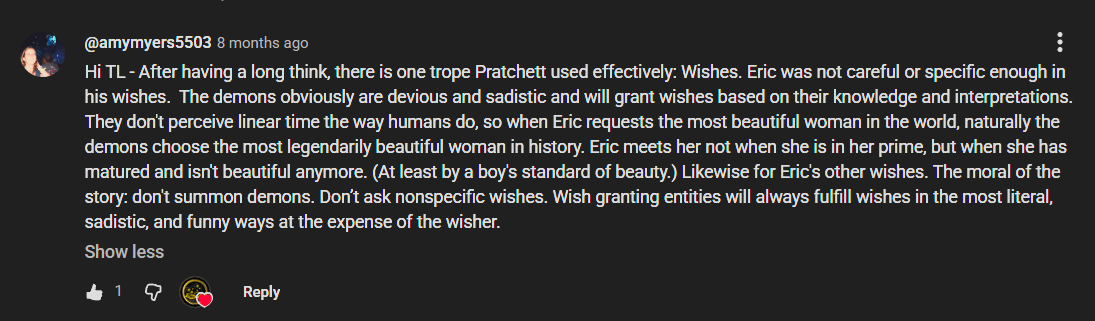
“After having a long think, there is one trope Pratchett used effectively: Wishes. Eric was not careful or specific enough in his wishes. The demons obviously are devious and sadistic and will grant wishes based on their knowledge and interpretations. They don't perceive linear time the way humans do, so when Eric requests the most beautiful woman in the world, naturally the demons choose the most legendarily beautiful woman in history. Eric meets her not when she is in her prime, but when she has matured and isn't beautiful anymore. (At least by a boy's standard of beauty.) Likewise for Eric's other wishes. The moral of the story: don't summon demons. Don’t ask nonspecific wishes. Wish granting entities will always fulfill wishes in the most literal, sadistic, and funny ways at the expense of the wisher.”
I truly had stopped thinking about the wish element of the book pretty early on while reading it and then again while I was writing this essay. I think Eric constantly begging and nagging just grated on me to such a degree I forgot Eric’s wishes were being granted in a monkey’s-paw sort of fashion. He did get his riches and kingdom, but only so he could be sacrificed. He met the most beautiful woman in all the land, but she had matured to a point that she was undesirable to this fourteen-year-old boy, and then he wanted to live forever… which I guess maybe was somewhat fulfilled by going back in time for a while? Perhaps? I’m not sure on that one. If anyone has a better idea of how this wish was twisted and granted, let me know, but I think that’s it.
Overall, you made a terrific point here; if you ever find yourself having one or more wishes, consult an attorney before wishing. Thanks, Amy!
Conclusion
Onto the Next
Well… that was Eric, our final single-digit Discworld novel. We next get to the Industrial Revolution with Moving Pictures, which I’m excited about as I genuinely do not remember much about this book. I think I may have only read it once or twice very long ago, so it’ll be like reading a new Pratchett novel for me.
Eric was not great; if you gave it 5 stars, I’d love to know why. If you’re just a diehard Pratchett fan and love every single thing he does, that’s totally fine! I love Pratchett, too. But this book just really let me down and left me eager to move on. I am pretty sure this is my least favorite Discworld novel, so at least it gets better from here, right?
Keeping This Going
Thank you so much for checking out this post. I know that the gap between these posts is less than desirable, but this is just a hobby for me, so it unfortunately falls by the wayside when other projects are ongoing. I worked hard last year—harder than anticipated—so I had little to no time to work on this. Even when I did have time, I felt so unmotivated to work on this essay because I just didn’t enjoy Eric. Thank you so much for your patience, comments, and support during the time between post. I love getting comments from people during the gaps between post, genuinely—it encourages me to get back to it more than anything.
The state of the world has also made it difficult to keep up with this project. Cost of living skyrocketing, federal agents murdering civilians left and right, neighbors getting snatched by masked strangers, AI ruining the world and my job… it’s tough to stay motivated during all of this, but I am doing my best. One thing that spurred me to get cracking on this was the knowledge that absurdism is needed more in hard times than it is in good ones. This world is tough and bleak, and absurdism is designed to make the horrors of the real world a little easier to approach. That’s part of why Terry Pratchett is my favorite storyteller—he acknowledges the awfulness of the world yet makes it approachable and even amusing. Death is my favorite character in Discworld and that’s a testament to how excellent Pratchett’s writing is.
Thanks for sticking with me. The post for Moving Pictures is already up as you’re reading this, so go check it out, provide a rating, and leave a comment once you’ve read the 10th Discworld novel. Hopefully, I’ll be more inspired with this next video. Thanks so much.
